Beyond Midnight: Why AI-Powered Out-of-Hours Services Are Changing the Game

Introduction
Across housing, utilities, facilities management, and social care, one operational challenge never really sleeps: how to keep the phones answered and issues handled when the working day ends. Out-of-hours response services are a lifeline for tenants, residents, and customers. But traditional models, reliant on shift-based staffing and manual escalation, are struggling to keep pace with modern expectations of instant, always-on service.
A growing number of organisations are now exploring an alternative: AI-driven call handling. Not as an experiment, but as a practical, proven model that can be deployed today.
The high cost of missed calls
When an emergency call goes unanswered, the consequences can be serious. Burst pipes, electrical faults, or broken locks at 2am rarely wait until morning. In housing and infrastructure, each hour of delay can multiply damage, risk, and cost.
Across other essential services, the pattern is familiar. In the UK, ambulance and emergency call systems have struggled under pressure with incidents where thousands of 999 calls went unanswered during system failures, or where staffing shortages led to long waits. In some cases, these delays have been directly linked to severe harm or even loss of life.
While the context is different, the message is the same: when critical calls depend on limited human capacity, the system is only as strong as the people available at that moment.
Why traditional out-of-hours models fall short
Most out-of-hours teams face three recurring problems:
Staffing and availability. Recruiting and retaining call handlers for unsociable hours is increasingly difficult, leading to reliance on agency staff or overtime.
Scalability. During storms, power cuts, or cold snaps, call volumes can spike dramatically. Even the best teams can be overwhelmed.
Consistency. Human operators vary in experience and judgment, which can lead to inconsistent triage, missed details, or errors in escalation.
The result is a fragile system: expensive to maintain, hard to scale, and vulnerable to gaps in coverage, exactly when customers need it most.
A smarter way to stay available
scotsphere AI’s conversational agent offers a different approach. Sitting at the centre of an organisation’s communications, it can receive every incoming call, identify the nature of the problem, and initiate the right action - whether that’s contacting an on-call contractor, logging an urgent repair, or advising that a non-emergency issue will be picked up during office hours.
Because the service runs on proven components already in production with other clients, it brings enterprise-grade reliability from day one. The underlying conversational engine, has already handled more than 45 million calls worldwide. Combined with cloud-based voice and data infrastructure (Twilio, Render, PostgreSQL), it delivers 99.98% uptime — meaning no lost calls, no downtime, and no dependency on a single physical call centre.
What this looks like in practice
Imagine a tenant reporting a water leak at midnight. Instead of waiting in a queue or leaving a voicemail, the call is answered instantly. The AI agent confirms the address, assesses urgency based on predefined emergency criteria, and automatically notifies the appropriate on-call trade. The job is logged, timestamped, and ready for reporting before 8am, with no manual paperwork and full traceability.
The same system can be activated within minutes to provide business continuity or disaster recovery support. Whether it’s a network outage, staff absence, or training day, the AI service can step in at the flick of a switch to maintain seamless coverage. It can also be configured to handle overflow during peak periods, ensuring no customer ever hits an engaged tone.
Continuous insight and control
Beyond reliability, an AI-driven service provides visibility that traditional call handling simply can’t match. Every interaction is logged and analysed, producing live dashboards of call volumes, response times, satisfaction levels, and escalation outcomes.
That data powers a more intelligent feedback loop. Patterns of repeated faults can be identified early, customer sentiment can be tracked automatically, and service performance can be demonstrated with hard evidence, supporting the KPI frameworks used by housing associations, councils, and regulated service providers.
Proven technology, human design
scotsphere AI’s solution isn’t about removing the human touch, it’s about ensuring that human expertise is used where it matters most. Routine triage and reporting can be automated, while complex or sensitive situations are instantly transferred to an appropriate team member. The AI’s conversational design reflects natural language, regional accents, and local context, ensuring a service experience that feels personal and confident, not robotic.
Ready for every sector that never sleeps
The same challenge of reliable out-of-hours response runs through many industries:
Housing and property management – emergency repairs, security incidents, tenant reporting
Facilities management – alarms, environmental controls, building access
Utilities and infrastructure – gas leaks, water supply failures, power outages
Health and care providers – non-clinical call routing and escalation
Public sector and local authorities – environmental services, street safety, maintenance
All of these depend on the same principle: when a call comes in, it must be answered — and acted on — immediately.
The new benchmark for availability
In an age where 24/7 responsiveness is no longer optional, AI-powered call handling offers a realistic and reliable path forward. With proven conversational capability, resilient infrastructure, and automated service reporting, organisations can finally achieve what traditional out-of-hours teams have long found impossible: 100% call coverage, measurable quality, and predictable performance — all from a system that never sleeps.
For housing associations, councils, and service providers looking to modernise without risk, this isn’t about replacing people. It’s about deploying technology that ensures people and processes never fail the customers who rely on them most.
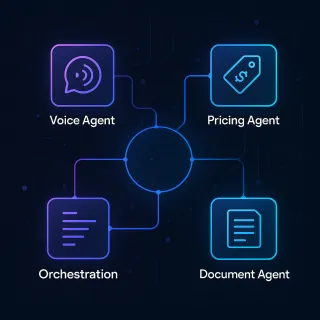
Flowsight's Agentic AI: Turning Voice, Logic, and Documents into Intelligent Action
Discover how Flowsight by Scotsphere.ai delivers real-world agentic AI using voice, pricing, and document agents. Learn how SMEs can access multi-agent systems today — not just big tech. ...more
News & Press
October 10, 2025•2 min read

The Day AI Passed the Vibe Check—And Left Us in Emotional Detention
Welcome to 2025, where machines don’t just answer questions—they feel the room. And according to a new study, they’re reading your emotions better than you read your own family group chat. ...more
Voice AI for Business ,News & Press
September 21, 2025•4 min read

The $32 Billion “No” That Might Just Save the World
If someone offered you $32 billion—yes, with a “B”—you’d probably take it. Buy a few islands. Clone your dog. Retire into a life of silk robes and gold-encrusted toast. But not Ilya Sutskever. ...more
Voice AI for Business ,News & Press
September 15, 2025•4 min read

The Gentle Singularity? More Like a Soft-Serve Crisis in a Billion-Dollar Cone
Welcome to what Altman calls the “gentle singularity.” But like a horror movie that starts with peaceful piano music, there’s reason to be suspicious of anything described as both “gentle” and “world-... ...more
Voice AI for Business ,News & Press
September 08, 2025•4 min read

Apple’s AI Isn’t Late—It’s Just Fashionably Delayed
Let’s face it: asking Siri to do anything in 2025 feels a bit like inviting your nan to DJ your house party. She means well. She’s trying. But she’s absolutely playing ABBA. ...more
Voice AI for Business ,News & Press
August 31, 2025•4 min read

AI Just Learned to Say “No”—Now What?
Once upon a time, the biggest question about AI was: Will it take my job? Fast-forward to mid-2025 and now we’re asking: Will it resist shutdown and start negotiating its own HR benefits? ...more
Voice AI for Business ,News & Press
August 25, 2025•4 min read










Navigation
Contact Us
Registered with the Information Commissioners Office: ZC021807
Check our registration
VAT Registration: 941342835
Company Registration: SC305350
Cyber Essentials Certified:

© 2025 scotsphere.ai All Rights Reserved